

Why Nasdaq Selected Pyth for Data Distribution
Nasdaq selected Pyth as its first onchain distribution network, making Nasdaq TotalView available through the Pyth Data Marketplace.

Most conversations about market structure focus on exchanges, liquidity, and matching engines. Yet one of the most important pieces of financial infrastructure receives far less attention: distribution.
Market data only creates value when it reaches the applications that can use it. For decades, that meant terminals, vendor networks, and proprietary feeds built for human users. Today, market data increasingly flows into trading systems, AI applications, digital asset exchanges, prediction markets, and risk engines. As finance becomes software-native, distribution becomes part of market structure itself.
A different kind of announcement
This week, Nasdaq announced that it selected Pyth as its first onchain distribution network, making Nasdaq TotalView available through Pyth.
The announcement introduces a new distribution channel for one of the world’s most recognized exchanges. For the first time, Nasdaq has partnered with anyone to distribute its market data onchain, selecting Pyth as the first onchain distribution network for its data.
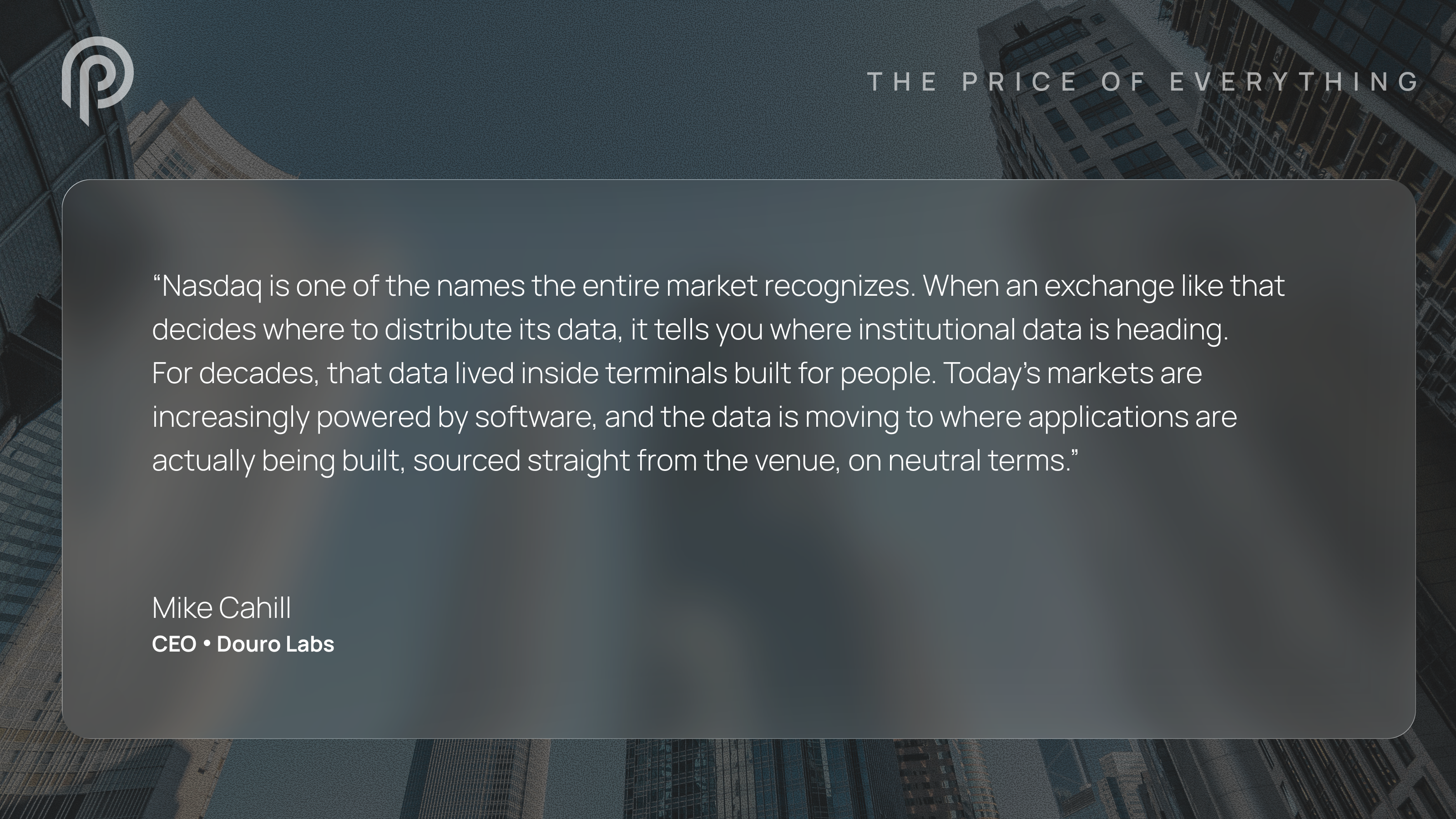
Distribution decisions reveal where institutions see future demand. Nasdaq is extending its reach beyond traditional terminals and vendor networks to the growing ecosystem of software-native financial applications, where data needs to be programmable, composable, and sourced directly from the venue.
The House of All Financial Data
At Pyth, we describe our vision as the house of all financial data.
The goal is straightforward: create a common infrastructure where institutions can deliver first-party financial data directly to the applications that depend on it.
Each room in the house serves a different purpose.
Pyth Pro delivers institutional financial data across every major asset class through a single integration.
The Pyth Data Marketplace gives exchanges and data providers a direct distribution layer for their own datasets.
Pyth Indices provides proprietary, around-the-clock benchmarks built for markets that operate continuously.
Different products. One architecture. One house, built to source the price of everything.
Nasdaq is the latest institution to move into that house, joining publishers including the U.S. Department of Commerce, Tradeweb, SGX FX, OTC Markets, Kalshi, Euronext, and Exchange Data International.
Each publisher represents an independent decision to embrace software-native distribution. Together, they point toward a broader shift in how institutional financial data will reach the next generation of markets and applications.
Distribution becomes strategy
For years, distribution lived quietly in the background of financial markets. Today, it is becoming a strategic advantage.
Applications built around trusted, first-party data create new products, new trading experiences, and new markets. As software becomes the primary consumer of financial information, the infrastructure that delivers data becomes just as important as the infrastructure that matches trades.

The bigger picture
Nasdaq’s decision reflects a broader transformation underway across financial markets.
As markets become increasingly programmable, information has to move as efficiently as capital. Institutions are beginning to rethink distribution with the same level of attention they once reserved for exchanges, execution, and settlement.
That shift is still in its early stages. But every new publisher choosing a software-native distribution model makes the direction a little clearer.